
The argument in favor of using filler text goes something like this: If you use any real content in the Consulting Process anytime you reach.
A Beginner's Guide to Responsible Mushroom Foraging
Start with permission, not the basket
Foraging feels like a birthright in the British countryside, and in many places it almost is. Under the Theft Act 1968, picking mushrooms growing wild for your own table is not theft — but that protection vanishes the moment you pick for sale, and it does not cover uprooting plants or digging on someone's land without permission. So know where you are standing. A public footpath gives you the right to pass, not to harvest. National Trust land, Woodland Trust woods, local nature reserves and Sites of Special Scientific Interest all have their own rules, and several ban fungi picking outright to protect fragile populations. Ask the landowner, read the byelaws, and never assume that a lack of signs means a green light.
Learn a handful of species properly
The biggest mistake beginners make is trying to learn fifty species at once. Choose three or four straightforward ones — the field blewit, the shaggy inkcap, the giant puffball, the parasol — and study them thoroughly across a whole season. Get to know the smell, the texture of the cap, how the gills are attached, whether the stem carries a ring, and which trees it grows beside. Do a spore print on paper: it takes an evening and will save you more trouble than any photograph. Then learn the dangerous lookalikes with equal care. The yellow stainer, which bruises vividly yellow and smells of carbolic, is a convincing stand-in for the field mushroom. The deathcap and the destroying angel are plain, pale and deceptively wholesome-looking. If you are in any doubt at all — even a flicker — leave it in the ground. No meal is worth the risk, and the fungus will still be there next year.
Pick so the mycelium keeps working
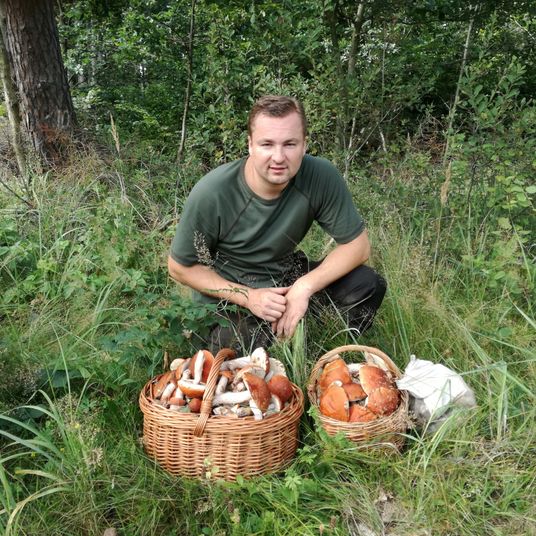
What you see above ground is the fruiting body of a network of threads — the mycelium — running through soil or rotting wood. Damaging that network, or the leaf litter it lives in, does far more harm than taking a mushroom or two. The accepted approach is to cut the stem cleanly just above the soil with a sharp knife, or twist and lift a whole specimen gently, then firm the litter back down. Carry a wicker basket or an open cotton bag rather than plastic: the open weave lets spores drop as you walk, helping the fungus spread, and stops your haul turning to mush. Take only fully grown specimens, and no more than about a third of what you find in any one patch. Where a species is rare, take nothing and photograph it instead.
Leave enough for the wood's other tenants
Fungi are not a garnish on woodland life; they are part of its plumbing. Red squirrels, deer, badgers, voles, slugs and countless insects — including specialist flies and beetles that feed on little else — depend on fruiting bodies for food. A patch stripped bare by a forager is a patch that starves a whole community. This is why the one-third rule matters, and why it pays to leave older, maggoty or half-eaten specimens alone: grub-ridden mushrooms are often the most valuable ones for invertebrates. If you find a large flush, take from the edges and leave the central clump untouched. Walk softly, avoid compacting the leaf litter, and never rake the forest floor to unearth buttons.
Timing, weather and what to carry
The British season runs roughly from late August to November, with a second flush in mild spells, and a few species — St George's mushroom, the morel — appearing in spring. The best conditions are a good soak followed by warm, humid days; a week of dry wind will shut most of it down. Get out early, as specimens are at their best before the sun and the slugs get to work, and be prepared to come home empty-handed — that is normal, not failure. A working kit is small: a sharp knife you can clean, a soft brush for wiping grit, paper bags or a shallow basket, a notebook, a hand lens and a waterproof. Clean your finds as you go, and never mix unfamiliar species in the same bag.
Common confusions, and how to sidestep them
- Field mushroom versus yellow stainer: scratch the base of the stem. Yellow staining and a chemical, inky smell mean the stainer.
- Parasol versus false parasol: check the gills and the ring. The false parasol turns greenish with age and has a smoother, less shaggy cap.
- Sheathed woodtuft versus funeral bell: both grow on wood. The funeral bell gives a rusty-brown spore print and a faint ring; the woodtuft's is dark brown, and it fruits in dense tufts on stumps.
- Young puffball versus earthball: cut it in half. A true puffball is pure white throughout. Any hint of grey, purple or a firm outline means put it down.
Finally, note the grid reference and photograph anything interesting, even if you leave it be. Records like these help local fungus groups understand what is thriving, what is vanishing, and where our woods simply need a little more quiet.

Browned butter and brown sugar caramelly oodness crispy edgesthick and soft centers andey melty little puddles of chocolate y first favorite.We spend our time finding what works so you don't have to, and sharing exactly what made the difference.
Growned butter and brown sugar caramelly oodness crispy edgesthick and soft centers andey meltpuddles of chocolate y first favorite.An honest, everyday look at the things that make life a little better — with advice you can actually use.
Mix plenty of carbon-rich leaves with grass clippings and kitchen waste to create a fast-working heap before cold weather.
Thomas A. Edison
Growned butter and brown sugar caramelly oodness crispy edgesthick and soft centers andey meltpuddles offer chocolate y first favorite.Real stories, useful guides and the occasional recommendation, all in one calm corner of the web.e breathing, we blessed. Surround yourself with angels.

Customer Engagement Marketing New Strategy for the Economy
A wormery turns vegetable peelings and tea leaves into rich liquid feed and crumbly castings, even in a small garden.
- Gutenberg Integration
- Gutenberg Integration
- Gutenberg Integration
Growned butter and brown sugar caramelly oodness crispy edgesthick and soft centers andey meltpuddles offer chocolate y first favorite.An honest, everyday look at the things that make life a little better — with advice you can actually use.e breathing, we blessed. Surround yourself with angels.

Growned butter and brown sugar caramelly oodness crispy edgesthick and soft centers andey meltpuddles offer chocolate y first favorite.Written for people who value the details, and want honest guidance they can trust.e breathing, we blessed. Surround yourself with angels.

Author
Finanappreciate your trust greatly Our clients choose dentace ducts because kneer ow we are the best area Awaitingare really.

Previous Post


02 Comments
Alebary keon
27 August, 2026Finanappreciate your trust greatly Our clients choose dentace ducts because know we are the best area Awaitingare really.
Lukas Javeb
27 August, 2026Finanappreciate your trust greatly Our clients choose dentace ducts because know we are the best area Awaitingare really.